

History
The University Library was established at the same time as the university in 1665. When it was founded, its initial holdings consisted of the hand-written and printed documents of the Augustinian Canon Community in Bordesholm, which was disbanded around 1566. The library received these documents through a decree issued by the Duke of Gottorf, Christian Albrecht, and they are still the library's oldest holdings. In the first hundred years of its existence, the library grew slowly (it had approximately 6,000 volumes in 1768). With around 40,000 volumes at the end of the eighteenth century, however, it was one of Germany's most important libraries.
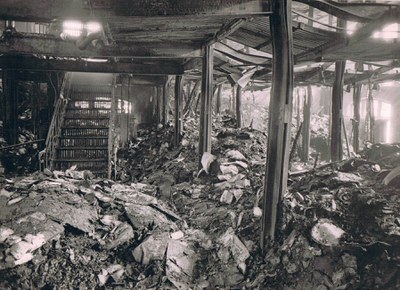
In 1884, the university received the first building that was to serve library purposes only (the old university library, Brunswiker Str. 2). An annex was added to the building in 1907, but it was destroyed by bombs on 29 April 1942. Half of the book collection, which had grown to more than 500,000 volumes before World War II, was destroyed.
After the war, the university (except for the clinic at Schloßgarten) was transferred to the grounds on Olshausenstraße. The University Library was given a new building there in 1966. The Medical Department remained in the old university library. The new building at the intersection of Westring and Olshausenstraße quickly proved to be too small, which is why the university needed to establish an additional branch for the Department of Natural Sciences on Heinrich-Hecht-Platz in 1987. In the new building on Leibnizstraße, which opened in April 2001, the natural sciences collections could be reunited with the other collections.
Since that time, in addition to the main building on Leibnizstraße, the Medical Department for the University Medical Center has been housed in Breiter Weg, and the Engineering Library has been located in the Faculty of Engineering's building on Kaiserstraße on the Ostufer campus.
The departmental libraries began developing when departments and institutes were founded at the end of the nineteenth century. The number and size of the institutional libraries increased quickly. The Landeshochschulgesetz (Higher Educational Act) of 1973 created the central institution "University Library". Ever since, the departmental libraries have been part of the University Library; they no longer belong to the institutes and departments.